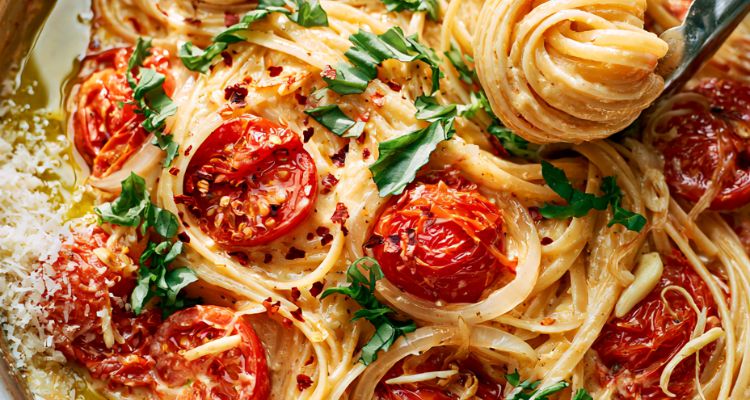
Martha Stewart one pot pasta from marthastewart.com cooks linguine, tomatoes, onion, garlic, and basil together in a single skillet with water that becomes the sauce as it reduces. And the dish serves 4 at approximately 420 calories per serving in just 20 minutes total, since there is no separate pot of water to boil.
Most pasta recipes boil noodles in one pot, build sauce in another, then combine them at the end. But Martha puts everything into a cold skillet with 4 1/2 cups of water and brings it all to a boil together. So the starch released from the linguine thickens the remaining water into a creamy sauce that coats every strand without any added cream or butter.
Stirring and turning the pasta frequently with tongs during the 9-minute boil is the step that prevents the strands from sticking into a solid clump. And if you leave the linguine sitting in the skillet without moving it, the noodles fuse together where they overlap and the water reduces unevenly around them.
Source: Martha Stewart (marthastewart.com)
Martha Stewart One Pot Pasta
Course: PastaCuisine: AmericanDifficulty: Easy4
servings30
minutes40
minutes300
kcalLinguine, halved tomatoes, sliced onion, garlic, red pepper flakes, basil sprigs, olive oil, salt, pepper, and water all go into a cold straight-sided skillet at once. Then 9 minutes of boiling with constant tossing cooks the pasta al dente while the water reduces into a starchy, clinging sauce.
Ingredients
- For the pasta:
12 ounces linguine
12 ounces cherry or grape tomatoes, halved or quartered if large
1 onion, thinly sliced (about 2 cups)
4 cloves garlic, thinly sliced
1/2 teaspoon red pepper flakes
2 sprigs basil, plus torn leaves for garnish
2 tablespoons extra-virgin olive oil, plus more for serving
2 teaspoons coarse salt
1/4 teaspoon freshly ground pepper
4 1/2 cups water
- For serving:
Freshly grated Parmesan cheese
Torn basil leaves
Extra-virgin olive oil
Directions
- Combine everything in the skillet: Place the pasta, tomatoes, onion, garlic, red pepper flakes, basil sprigs, olive oil, salt, pepper, and water in a large straight-sided skillet.
- Bring to a boil: Then set the skillet over high heat and bring the mixture to a boil.
- Cook and toss constantly: Once boiling, stir and turn the pasta frequently with tongs for about 9 minutes.
- Check the pasta: When the linguine is al dente and the water has nearly evaporated, the sauce should cling to each strand.
- Season and serve: Then taste for salt and pepper, divide among 4 bowls, and garnish with torn basil, a drizzle of olive oil, and grated Parmesan.
FAQs
Why does this recipe use a skillet instead of a pot?
A straight-sided skillet spreads the pasta in a wider, shallower layer so every strand contacts the liquid evenly. And a deep pot submerges the noodles in too much water, which means the starch dilutes instead of concentrating into a creamy sauce.
But the skillet needs to be large enough to hold the linguine without crowding, because overlapping pasta sticks together. Since a 12-inch straight-sided skillet fits 12 ounces of linguine with room to toss, that size is the sweet spot for this technique.
Can I use a different pasta shape?
The source page says other shapes work as long as they have the same cooking time as linguine, which is about 9 minutes. And spaghetti is the closest swap since it is a similar long noodle that cooks at the same rate.
But shorter shapes like penne or rigatoni take longer to cook, so they would need more water and a different timing. Since the 4 1/2 cups of water is calibrated to reduce completely during the 9-minute boil, changing the pasta shape means recalculating the liquid ratio.
H3: What can I add for more protein or flavor?
The source page suggests swapping half the water for chicken or vegetable broth to deepen the base flavor. And anchovy paste, fish sauce, capers, or olives add umami without changing the technique.
Shredded rotisserie chicken or sautéed shrimp toss in at the end once the pasta is cooked, since adding raw protein to the boiling skillet throws off the water ratio. And for another Martha Stewart recipe built on the same minimal-ingredient philosophy, the martha stewart roast chicken uses just salt and olive oil, so leftover meat from that bird shreds perfectly into this pasta.
Why is my sauce too watery or too dry?
If the sauce is watery after 9 minutes, the heat was too low and the water did not reduce fast enough. So keep the skillet at a rolling boil the entire time, because a gentle simmer leaves too much liquid behind.
And if the sauce is too thick or the pasta sticks, you cooked it too long or started with too little water. Since the 4 1/2 cups is precise, measure it rather than eyeballing, because even half a cup less changes the outcome.
How should I store and reheat leftovers?
The pasta keeps in an airtight container in the fridge for up to 2 days, though the noodles absorb the remaining sauce as they sit. And reheating in a skillet over medium-low with a splash of water and a drizzle of olive oil loosens the pasta back to a saucy consistency.
But do not microwave without adding liquid, because the dry heat tightens the starch and the linguine turns gummy. And for another Martha Stewart recipe where stovetop reheating beats the microwave, the ketchup glaze on the martha stewart meatloaf also warms more evenly in an oven or skillet than in short microwave bursts.