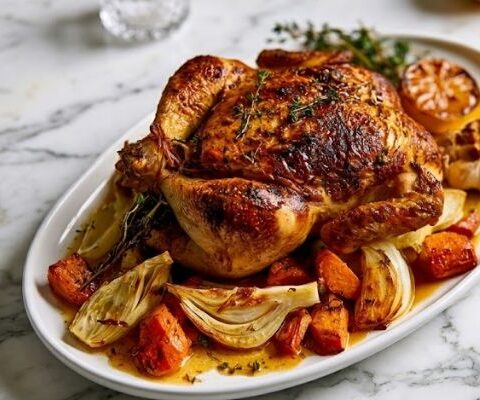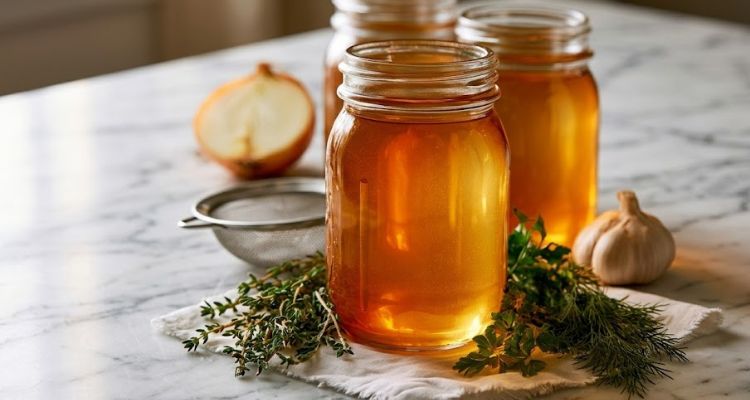
Ina Garten chicken stock from Barefoot Contessa Family Style simmers three whole chickens with onions, carrots, celery, and fresh herbs for 4 hours. And the batch yields 6 quarts at about 40 calories per cup, since the overnight chill lets you skim the fat clean.
Most stock recipes call for bones or carcasses, but Ina uses three full 5-pound roasting chickens for maximum flavor. And she leaves the onion skins and carrot peels on, which adds golden color to the broth without any extra steps.
Simmering uncovered for the full 4 hours is non-negotiable here, because a lid traps steam and dilutes the stock instead of concentrating it. And a covered pot also runs hotter, which clouds the liquid since the rolling boil breaks down proteins into murky particles.
Source: Barefoot Contessa Family Style (2002, Clarkson Potter)
Ina Garten Chicken Stock
Course: SidesCuisine: AmericanDifficulty: Easy4
servings20
minutes4
hours40
kcalEverything goes into one large stockpot with 7 quarts of water, comes to a boil, and simmers uncovered. Then the liquid strains through a colander, chills overnight, and the solidified fat lifts off the surface the next morning.
Ingredients
3 (5-pound) roasting chickens
3 large yellow onions, unpeeled and quartered
6 carrots, unpeeled and halved
4 stalks celery with leaves, cut into thirds
4 parsnips, unpeeled and cut in half (optional)
20 sprigs fresh parsley
15 sprigs fresh thyme
20 sprigs fresh dill
1 head garlic, unpeeled and cut in half crosswise
2 tablespoons kosher salt
2 teaspoons whole black peppercorns
Directions
- Load the pot: Place the chickens, onions, carrots, celery, parsnips, parsley, thyme, dill, garlic, salt, and peppercorns in a 16 to 20-quart stockpot.
- Add the water: Then pour in 7 quarts of water and bring everything to a boil.
- Simmer uncovered: Once boiling, reduce the heat and simmer uncovered for 4 hours.
- Strain the stock: After 4 hours, pour the entire contents through a colander and discard all the solids.
- Chill overnight: Then transfer the strained stock to containers and refrigerate overnight.
- Skim the fat: The next day, remove the layer of solidified fat from the surface.
- Store or freeze: Then use immediately, or pack in containers and freeze for up to 3 months.
FAQs
Can I use fewer chickens or just bones instead?
Three whole chickens give the stock a body and richness that bones alone cannot match, since the meat releases gelatin and flavor as it breaks down over 4 hours. And cutting the recipe to one chicken with 2 to 3 quarts of water works, but the yield drops proportionally.
Leftover carcasses or wings can substitute if cost is a concern, though the stock will taste lighter. So if you go that route, roast the bones at 400°F for 30 minutes first, because browning adds depth that raw bones lack.
Why does Ina leave the vegetables unpeeled?
Onion skins give the stock a rich golden color that peeled onions cannot, and the carrot and parsnip peels add earthy sweetness without extra prep. Since everything gets strained and discarded after 4 hours, peeling is wasted effort.
But wash the vegetables well before adding them, because dirt on the skins clouds the finished stock. And trim any bruised or soft spots from the carrots and parsnips, since those areas can turn the broth bitter during the long simmer.
Do I need a 16-quart pot or can I use something smaller?
The three chickens plus 7 quarts of water need a very large pot, so anything under 16 quarts overflows once the liquid heats and rises. And a crowded pot also makes it hard to maintain a gentle simmer, which is critical for a clear stock.
But if your largest pot is 12 quarts, halve the recipe to 1 1/2 chickens with 3 1/2 quarts of water. Since the ratio stays the same, the flavor concentrates at the same rate and you still get a clean, rich result.
How do I know when the stock is done?
After 4 hours the liquid should taste deeply savory on its own and the chicken meat should be falling apart on the bones. And the volume reduces during the uncovered simmer, so expect about 6 quarts from the original 7 quarts of water.
But do not rush the process by raising the heat, because a hard boil emulsifies the fat and makes the stock greasy and cloudy. So keep the surface at a lazy bubble where small wisps of steam rise, since patience is the only technique this recipe actually needs.
What is the best way to freeze chicken stock?
Quart-sized freezer bags laid flat stack neatly and thaw faster than rigid containers. And labeling each bag with the date helps you rotate through the oldest stock first, since it keeps frozen for up to 3 months.
But leave an inch of headspace in each container or bag, because the liquid expands as it freezes. And for smaller portions, pour the stock into ice cube trays and transfer the frozen cubes to a bag, since each cube is about 2 tablespoons and perfect for deglazing a pan.