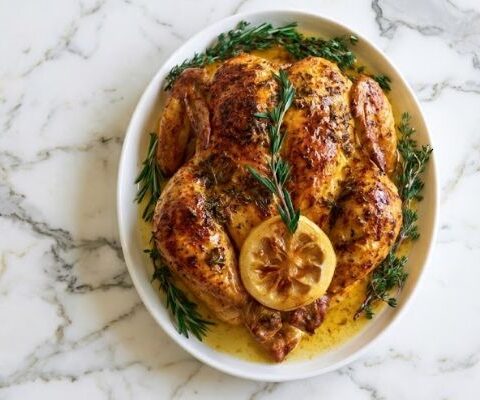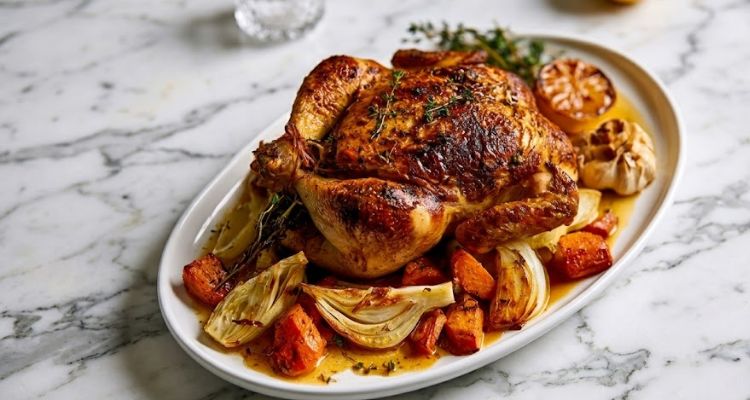
Ina Garten perfect roast chicken from Food Network stuffs a whole bird with thyme, lemon, and garlic, then roasts it at 425°F on a bed of vegetables. And at approximately 480 calories per serving, the full recipe takes 2 hours and 10 minutes for 8 since that includes a 20-minute rest.
What sets this version apart is that Ina roasts the chicken directly on top of the onions, carrots, and fennel. So the drippings baste the vegetables from above while the hot oven crisps the skin, which means the side dish cooks in the same pan.
Tying the legs together and tucking the wing tips under the body seems like a small detail, but it changes everything. Since a compact shape lets the heat circulate evenly, an untrussed bird dries out at the joints while the breast stays undercooked.
Source: Ina Garten (Food Network), verified from foodnetwork.com
Ina Garten Perfect Roast Chicken
Course: ChickenCuisine: AmericanDifficulty: Easy8
servings20
minutes1
hour30
minutes480
kcalMelted butter brushes the skin before a 5 to 6-pound chicken goes into a 425°F oven with its cavity packed full of aromatics. Then sliced onions, chunked carrots, and fennel wedges tossed in olive oil and thyme roast underneath for 1 1/2 hours.
Ingredients
- For the chicken:
1 (5 to 6-pound) roasting chicken
Kosher salt
Freshly ground black pepper
1 large bunch fresh thyme
1 lemon, halved
1 head garlic, cut in half crosswise
2 tablespoons (1/4 stick) butter, melted
- For the roasting vegetables:
1 large yellow onion, thickly sliced
4 carrots, cut into 2-inch chunks
1 bulb of fennel, tops removed and cut into wedges
20 sprigs fresh thyme
Olive oil
Kosher salt and freshly ground black pepper
Directions
- Preheat the oven: Heat to 425°F.
- Prep the chicken: Then remove the giblets, rinse inside and out, trim excess fat and pin feathers, and pat the outside dry.
- Season the cavity: Once dry, salt and pepper the inside generously.
- Stuff the chicken: Then push the bunch of thyme, both lemon halves, and all the garlic into the cavity.
- Brush and season the outside: Once stuffed, brush the skin with melted butter and sprinkle with more salt and pepper.
- Truss the bird: Then tie the legs together with kitchen string and tuck the wing tips under the body.
- Prepare the vegetables: Before placing the chicken, toss the onion, carrots, and fennel with salt, pepper, 20 thyme sprigs, and olive oil.
- Build the roasting pan: Then spread the vegetables across the bottom of a roasting pan and set the chicken on top.
- Roast the chicken: Once positioned, roast for 1 1/2 hours until the juices run clear between the leg and thigh.
- Rest before carving: Then remove the chicken and vegetables to a platter and cover with foil for 20 minutes.
- Slice and serve: After resting, carve the chicken and serve it on the platter with the roasted vegetables.
FAQs
How do I know when the chicken is fully cooked?
Ina checks by cutting between the leg and thigh and looking for clear juices with no pink. But a meat thermometer is more reliable, and the thickest part of the thigh should read 165°F before you pull it from the oven.
And the breast meat cooks faster than the thighs, so inserting the thermometer in the right spot matters. Since the thigh is the last part to finish, testing there guarantees every section has reached a safe temperature.
Why does the recipe call for such a high oven temperature?
Roasting at 425°F crisps the buttered skin fast while the lemon and garlic steam inside the cavity to keep the meat moist. And a lower temperature like 350°F dries out the breast before the skin turns golden, since the bird sits in the oven longer.
But check at the 1-hour mark if your oven runs hot, because the skin can go from golden to charred quickly at this temperature. And if the top browns too fast, tent loosely with foil for the remaining time so the thighs finish without burning the breast.
Can I skip the fennel in the roasting vegetables?
Fennel softens into sweet, caramelized wedges under the chicken drippings, so removing it changes the flavor of the vegetable bed. But if you do not like fennel, extra carrots or chunks of parsnip fill the space and roast at the same rate.
And celery stalks cut into 2-inch pieces also work, since they hold up for 1 1/2 hours without turning to mush. But avoid soft vegetables like zucchini or tomatoes, because they break down too fast and turn the pan bottom watery.
Why does the chicken rest for 20 minutes after roasting?
Resting lets the juices redistribute from the center back into the outer meat, so slicing too early sends those juices running onto the cutting board. And 20 minutes under foil keeps the chicken warm enough to serve while the proteins relax.
But do not wrap the foil tightly, because trapped steam softens the crispy skin you spent 1 1/2 hours building. So tent it loosely so air still circulates, and carve on the platter itself to catch any juices for spooning over the sliced meat.
What should I do with the leftover carcass?
The roasted bones, lemon, garlic, and thyme inside the cavity are a ready-made stock starter. And you can add the carcass to a pot with water, an onion, and a carrot, then simmer for 3 to 4 hours for homemade stock.
Since the bones are already roasted, the stock picks up a deeper color and richer flavor than raw-bone versions. And freeze the finished stock in quart bags laid flat, because they thaw faster than rigid containers when you need stock for a quick soup.