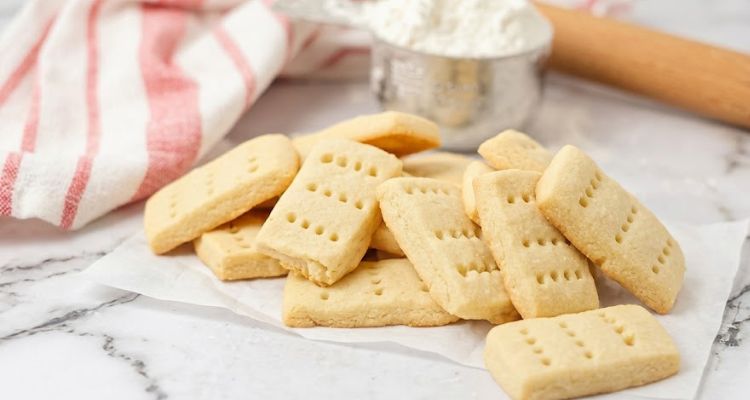
Martha Stewart shortbread cookies use just five ingredients: flour, butter, confectioners’ sugar, vanilla, and salt, then chill twice before baking at 325°F until golden. And the recipe makes 24 cookies at around 115 calories each in about 2 hours, since most of that time is the dough firming up in the fridge.
Where most shortbread recipes use granulated sugar, Martha Stewart calls for confectioners’ sugar instead, which contains a small amount of cornstarch. That powdery texture creates a cookie that is crisp on the outside but melts on the tongue, while granulated sugar would produce a crunchier, grittier bite.
Skipping either of the two chill steps wrecks the shape of every cookie, because warm butter-heavy dough spreads the moment it hits the oven. The first hour firms the dough enough to roll, and the second 30 minutes after cutting locks the shapes in place so they hold their edges during baking.
Source: Martha Stewart website
Martha Stewart Shortbread Cookies
Course: DessertsCuisine: AmericanDifficulty: Easy24
servings20
minutes115
kcalButter beats until fluffy before confectioners’ sugar and vanilla fold in, then a whisked flour and salt mixture brings the dough together on low speed. Two disks wrap and chill for an hour before rolling to 1/4-inch thick and cutting into shapes. And a second 30-minute chill after cutting keeps the cookies from spreading, so 13 to 15 minutes at 325°F turns them firm and golden.
Ingredients
For the dough:
2 cups all-purpose flour
3/4 tsp salt
8 oz (2 sticks) unsalted butter, room temperature
1/2 cup confectioners’ sugar
1 tsp pure vanilla extract
Directions
- Prep the sheets: Line 2 rimmed baking sheets with parchment paper, then whisk the flour and salt together in a bowl and set aside.
- Beat the butter: In a stand mixer with the paddle attachment, beat the butter on medium speed for 3 to 5 minutes until fluffy and light.
- Add the sugar: Then add the confectioners’ sugar and beat about 2 more minutes until pale and fluffy, scraping the sides as needed.
- Mix in the vanilla: Beat in the vanilla extract, since it adds an aromatic layer that traditional Scottish shortbread doesn’t include.
- Add the flour: Pour in the flour mixture and mix on low speed just until the dough sticks together when squeezed, because over-mixing develops gluten and toughens the cookies.
- Form and chill the dough: Turn out the dough, press into 2 flat disks, wrap each in plastic, then refrigerate at least 1 hour until firm.
- Preheat the oven: Set it to 325°F while the dough finishes chilling.
- Roll and cut: Roll one disk to 1/4-inch thickness on a lightly floured surface, then cut shapes with your preferred cookie cutter and transfer to the prepared sheets. Reroll scraps and repeat with the second disk.
- Chill again: Refrigerate the cut cookies for at least 30 minutes, since this second chill locks the shapes so they don’t spread in the oven.
- Bake until golden: Cook for 13 to 15 minutes until firm and lightly golden, then cool completely on a wire rack before handling.
FAQs
Why does the recipe use confectioners’ sugar instead of granulated?
Confectioners’ sugar contains a small amount of cornstarch, which absorbs moisture and creates a cookie that snaps cleanly but dissolves on the tongue. Granulated sugar produces a crunchier texture with visible crystals, which changes the delicate, melt-in-your-mouth quality that defines shortbread.
The finer powder also blends into the butter more smoothly, since there are no large crystals to cream around. That even distribution is what gives these cookies their uniform, tender crumb from edge to center.
Why does the dough chill twice?
The first chill firms the high-butter dough enough to roll without sticking to the counter or tearing under the pin. Without that hour, the dough is too soft to handle and the cookies come out uneven.
The second chill after cutting locks the shapes in place, because warm cut-outs spread and lose their edges the moment they hit a hot oven. Those 30 minutes are the difference between clean geometric shapes and rounded blobs. For another Martha Stewart recipe where chilling the dough is critical, try her Martha Stewart pie dough which uses the same cold-butter principle.
Can I add flavors to the basic dough?
Martha suggests rubbing citrus zest into the sugar with your fingertips before creaming it with the butter, using 1 to 2 teaspoons of orange, lemon, or lime zest for a subtle note. A full tablespoon gives a more forward citrus flavor.
Dipping cooled cookies halfway into melted chocolate is another option, and dark chocolate with crushed pistachios or white chocolate with dried cranberries are both suggested. Let the chocolate set completely on parchment before stacking, since warm chocolate smears against anything it touches.
How should I store these cookies?
Fully cooled shortbread keeps at room temperature in an airtight container for up to 2 weeks, which makes them one of the longest-lasting homemade cookies you can bake. The low moisture and high butter content slow staling, so they stay crisp well past the first few days.
Freezing works for up to 3 months if you layer the cookies between sheets of parchment or wax paper inside an airtight container. Thaw at room temperature, since the microwave softens them unevenly.
Can I freeze the dough instead of baking it all at once?
The wrapped disks freeze well for up to 2 months, so you can bake half now and save the rest for later. Thaw overnight in the fridge before rolling, because going straight from the freezer to the counter creates condensation that makes the surface sticky.
You can also freeze the cut shapes on a sheet until solid, then transfer to a bag and bake straight from frozen with 2 to 3 extra minutes added. That approach gives you fresh cookies on demand without any mixing. And for another Martha Stewart cookie that freezes well in dough form, her Martha Stewart blueberry muffins use a similar bake-from-cold strategy for quick mornings.